
Awards
Excellence in rural journalism celebrated at the National Rural Press Club Awards
The National Rural Press Club Awards Spotlight Domestic Violence, Climate Disasters and Critical Policy Reporting
20 November 2025
Domestic violence, climate disasters and consumer expectations around agriculture were some of the major themes highlighted by the winners of the the National Rural Press Club Awards this year.
Run by the National Rural Press Club (NRPC) based in Canberra, the Awards celebrate reporting on national policy issues important to rural and regional Australia. The award winners were announced on Thursday.
President of the NRPC, Gabrielle Chan said it was heartening to see such quality reporting and photographic work in the face of dwindling resources to fund rural stories and and rural media outlets.
“It is a testament to the dedication of all the journalists and photographers who entered that they continue to produce such compelling work under such difficult circumstances.”
Chan said the awards would not be possible without the generous support of Westpac, Nutrien, CropLife and the National Press Club.
ABC reporters Harrison Tippet and Bec Symons won the Croplife best news story for their story Regional Victorians almost twice as likely to experience family violence. The judges said it provided a comprehensive analysis of violent family offences, with a strong and audience-specific angle and clear policy points.
Tippet also won the Nutrien Journalist of the Year for his body of work which included exclusive news breaks, unique analysis and human-interest features delivered with sensitivity. Judges noted Tippet’s dexterity, with reporting skills in radio, broadcast and online, as journalist, photographer and videographer. Pip Courtney was runner up in that category.
“It's an honour to do the work we do in regional Victoria,” said Tippet. “A lot of people see regional and rural journalism as a stepping stone, but once you've done it for a while, you can see why so many people just make a full career out of it.”
Symons said she was grateful for the recognition for a nationwide policy issue.
“So many women who have gone through domestic violence don’t have a voice and we only hear their stories once they’ve been killed. To see our investigation honoured in this way gives me hope that society is changing. I’m truly grateful,” Symons said.
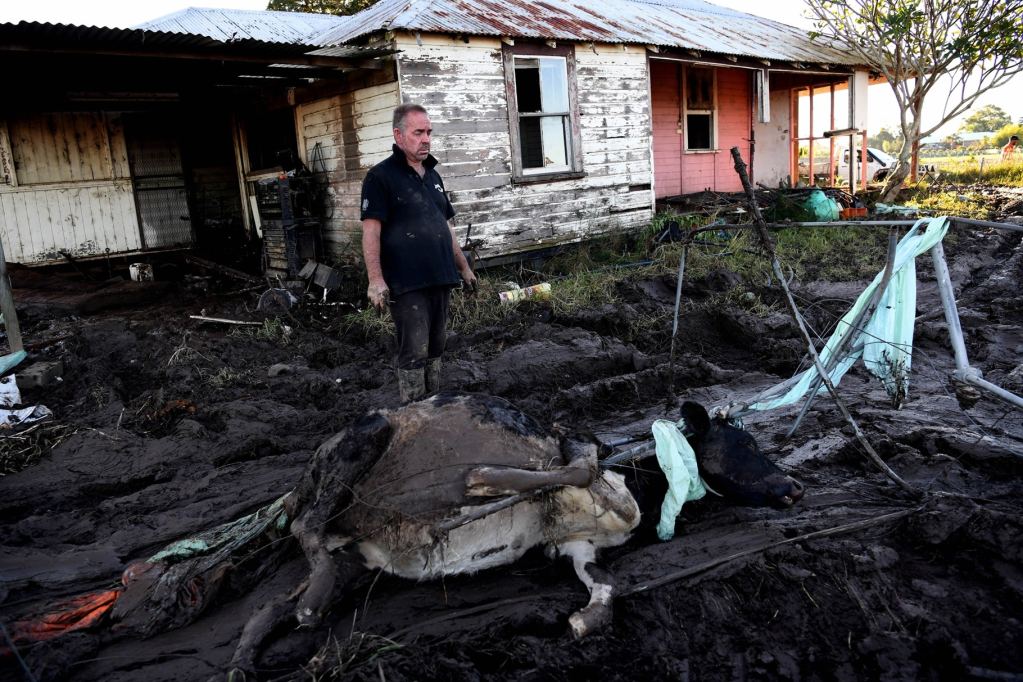
Freelance photographer Dean Sewell, shooting for the Guardian, won the National Press Club’s photographer of the year award for his remarkably graphic work reporting from Taree’s floods during the year.
As rural Australia reels from increasing climate disasters, Sewell’s work captures the heartache of a dairy farmer struggling to bury his beloved milking cows. Judges said Sewell’s series was a standout amongst the entrants this year.
“Just watching him drag the cows unceremoniously into a pit, you could see we were watching his life, his whole livelihood, being buried,” Sewell said.
Land journalist Eliza Spencer won Westpac’s Young Journalist of the Year, impressing the judges with her portfolio of work after less than two years reporting experience.
Judges said Spencer had a strong grasp of the issues relevant to the readership, covering key policy developments for the community and prompting interaction with readers both in print and online – via online comments and letters to the editor.
Judges made a special effort to highly commend Brooke Littlewood of the Farm Weekly for her portfolio, noting her entry was wide-ranging and included detailed, audience-focused coverage.
Her work on the live sheep export debate and support packages, was arguably the most significant national policy issue affecting her readers. The entry also included a breadth of wonderful community profiles.
National Press Club Photograph of the Year
- Winner: Dean Sewell
CropLife Best News Story
- Winner: Harrison Tippet and Bec Symons
Westpac Young Journalist
- Winner: Eliza Spencer
Nutrien Journalist of the Year
- Winner: Harrison Tippet
- Runner up: Pip Courtney
- Highly commended: Brooke Littlewood
Find out more about the award here.
Media Enquiries:
Georgie Robertson
0417 217 869
Categories

Crop Life Best News Story Award ($2,000)
Eligibility: Rural newsrooms are under extraordinary pressure to cover large areas and complex topics with dwindling resources. The CropLife Best News Story award recognises excellent news breaking by a rural journalist under pressure from deadlines. Entries must relate to rural and regional Federal policy issues, with stories published or broadcast between October 31, 2024 and October 31, 2025. Entry is open to all paid up members of the National Rural Press Club.
Judging criteria: The award recognises outstanding work on a developing news story which reveals significant new information about an issue affecting rural and regional Australia. Stories will be judged according to their newsworthiness, accuracy, clarity, originality and depth. Judges will also take into account the resources available to the journalist and whether they are regionally based.
Process: Applicants must submit a 200 word supporting summary describing:
- how the story came about,
- resources available to the journalist,
- where they were based,
- where it was published/broadcast,
- its impact and feedback generated.
Submissions can be a single report or up to three reports on the same issue per entry. Reports can be submitted in PDF files, accessible weblinks, audio or video links. Please note: weblinks will only be accepted if they are freely accessible without registration or paywalls. If the work you are entering is behind a paywall, it is strongly advised that you also upload an accessible copy with your entry, such as a PDF file. Your entry may be disqualified if the judges cannot access your work.

Westpac Judges’ Choice for Best Young Journalist
Eligibility: The National Rural Press Club recognises the challenges for young rural journalists in an era of shrinking regional news budgets. The Judges’ Choice award recognises a young rural journalist in the early stage of their career (under 30 years) who has shown a talent for and a commitment to reporting issues that matter to rural and regional Australia. Entry is open to all paid up members of the National Rural Press Club.
Judging criteria: Rural journalists work under extraordinary and diverse conditions across the country on multiple platforms, with access to varying levels of resources. Judges will assess the entries on consistency in timeliness, accuracy, context, balance and impact. Judges will also take into account the resources available to the journalist and their working conditions.
Process: Applicants must submit a 200 word supporting summary describing:
- how the portfolio reflects the journalist’s experience and skill,
- how the stories came about,
- resources available to the journalist and working conditions,
- where they were based,
- where it was published/broadcast,
- impact and feedback generated.
PDF files or audio or video links of stories must also be provided however weblinks will only be accepted as long as they can be freely accessed without registration or paywalls. If the work you are entering is behind a paywall, it is strongly advised that you also upload an accessible copy with your entry such as PDFs for stories. Your entry may be disqualified if the judges cannot access your work.

National Press Club of Australia Best Photograph of the Year Award ($2,000)
Eligibility: Photographs must relate to rural and regional Federal policy issues, taken in a rural area with pictures published between October 31, 2024 and October 31, 2025. The Photograph must be produced as an act of journalism, and not for advertising or public relations purposes, the work must be free from any commercial or corporate interests. All entries must be factually based. Publication on social media is accepted as published. Entry is open to all paid up members of the National Rural Press Club.
Judging criteria: The photograph will be judged according to the value it adds to the overall story, the technical skill and creativity of the photographer as well as its impact.
Process: Applicants must submit a 200 word supporting summary of how the photograph came about, where it was published and/or broadcast and what impact it had on the target audience.
Format: Entries should include a weblink to the photo publication and a JPEG file of the photograph, in its original pixel dimensions as shot. Please note, if your work is behind a paywall, it is strongly advised that you also upload an accessible copy with your entry as published, such as a PDF as well as the JPEG file. Your entry may be disqualified if the judges cannot access your work.
Use of AI is not permitted and only minimal editing for exposure and contrast is permitted. The use of cloning technology to alter the photograph is forbidden. The content of an image must not be altered. No hand of god image manipulation is allowed. Only retouching that conforms to currently accepted standards in the industry. No montaging or digital manipulation other than cropping, ‘digital spotting’, burning and dodging is permitted. The judges will be the arbiter of these standards and their decision will be final. The judges may ask to see your raw camera files.
Metadata which should be filled out such as the creation date, place and country as well as the caption/description and copyright must be provided. It can be included in the metadata of the image files or entered as part of the entry.
Nutrien NRPC Journalist of the Year
($5000 towards travel to the 2025 IFAJ Congress in Kenya)
Eligibility: The Journalist of the Year award recognises a body of work from a journalist working to tell the stories that matter to rural and regional Australia. Works can be news, feature or analysis across print/online and/or broadcast, published between October 31, 2024 to October 31, 2025. The works do not need to be related or share the same subject but must show a commitment to telling stories about and from rural and regional Australia.The winner will be awarded up to $5,000 to attend the International Federation of Agricultural Journalists Congress. Entry is open to all paid up members of the National Rural Press Club.
Judging criteria: Rural journalists work under extraordinary and diverse conditions across the country on multiple platforms, with access to varying levels of resources. They have to use different news categories including news, features, video and audio to tell a story. Judges will assess the entries on consistency in timeliness, accuracy, context, balance, originality and impact. Judges will also take into account the resources available to the journalist and their working conditions.
Process: The entry must include a 200 word supporting summary describing:
- how the portfolio reflects the journalist’s experience and skill,
- how the stories came about,
- resources available to the journalist and working conditions,
- where they were based,
- where it was published/broadcast,
- impact and feedback generated.
PDF files or audio or video links of stories must be provided however weblinks will only be accepted if they can be freely accessed without registration or paywalls. If your work is behind a paywall, it is strongly advised that you also upload an accessible copy with your entry, such as a PDF. Your entry may be disqualified if the judges cannot access your work.
National Rural Press Club terms and conditions
- Entrants accept that responsibility lies with them to ensure submitted works can be accessed by judges and the National Rural Press Club (NRPC) throughout 2025, and that failure to do so could disqualify an entry.
- The NRPC and the judges have the right to reject an entry that in their opinion does not comply with the requirements of the competition. The judges’ decision will be final. ● The NPRC reserves the right to withdraw the Award if it later finds the entrant did not comply with any entry conditions.
- In the event of any complaint, the entrant agrees to cooperate with the NRPC in any investigation that may be deemed necessary.
- Entrants must declare any and all use of artificial intelligence (AI) used in producing the works entered and preparing their submission. This includes but is not limited to the use of generative AI technology to create text, artwork, photography, data visualisation, and other graphics.